Insulation of external walls

Саниране на външни стени Insulation of external walls

Exterior wall renovation – protection and aesthetics

Renovating exterior walls is a key process that not only enhances the appearance of your property but also ensures protection against weather conditions, moisture, and other damaging factors. It is an investment that can increase the building’s energy efficiency and reduce future repair costs while keeping your home cozy and protected.

Key factors in exterior wall renovation

To achieve optimal results, it is important to consider the following factors:

  • Surface condition – Assess whether the walls show significant cracks, peeling sections, or other visible damage.

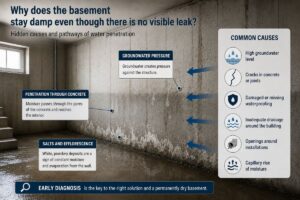
  • Moisture and weather conditions – Analyze the level of humidity in the area and the impact of precipitation and temperature fluctuations on the structure.

  • Insulation and waterproofing – Ensure that the current insulation meets standards and can effectively prevent water infiltration.

  • Material quality – Select durable materials that guarantee long-lasting repairs.

Preparation and technical recommendations

Before starting the renovation, it is crucial to prepare the surface for the new layer and meet technical requirements:

  • Cleaning – Remove all dirt, old paint, dust, and other residues to ensure proper adhesion.

  • Removing weak layers – Eliminate peeling sections and corroded elements that may interfere with the new material.

  • Priming – Apply a special primer that will improve the adhesion of the insulation materials to the surface.

Choosing the right waterproofing

Waterproofing is the core of the renovation, and its selection should be tailored to the specific needs of your property:

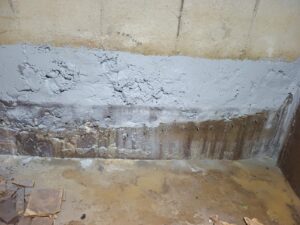
  • Cement-based mixtures with additives – Suitable for older structures, providing a strong and solid finish.

  • Polymer membranes – Ensure a flexible and resilient barrier that adapts to structural movements.

  • Liquid waterproofing – Forms a seamless, uniform layer that conforms to surface irregularities.

  • Crystalline waterproofing – Reacts with moisture, forming crystals to seal micro-cracks and provide effective protection.

Quality control and final touches

After completing the main work, final inspections and detailed finishing are essential to the durability of the renovation:

  • Final inspections – Conduct a thorough check of the applied materials to ensure there are no defects.

  • Sealing joints – Apply additional sealing layers in critical areas for extra durability.

  • Regular maintenance – Schedule periodic inspections to detect potential new problems and take corrective actions in time.

Conclusion: an investment in the future of your home

Conclusion: an investment in the future of your home

Exterior wall renovation is not just a repair activity—it is a strategy for protecting and enhancing your property. By choosing high-quality materials and relying on professional contractors, you ensure reliable and long-lasting protection that meets modern standards. Take the first step toward a safer, more beautiful, and energy-efficient space and enjoy the investment in the future of your home!

Concrete strength, how is it achieved 1
Blog
Site Admin Y

Concrete strength, how is it achieved?

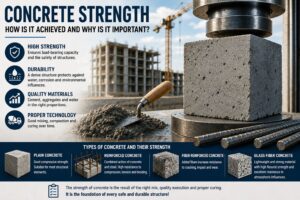
Concrete is one of the most widely used construction materials in the world. The reason is simple. It combines high load-bearing capacity, excellent durability, and a long service life. When discussing concrete strength, the term usually refers to its ability to withstand compressive forces without failure. This property determines whether a structure will remain safe and reliable for decades. Strength does not depend solely on the amount of cement used. The water-to-cement ratio, the quality of the aggregates, proper mixing, effective compaction, and correct curing all play a crucial role. Even concrete made with an excellent mix design can develop lower strength if it is not kept sufficiently moist during the first few days after placement. Cement hydration occurs gradually, creating the internal structure that provides the required mechanical resistance. International construction standards determine concrete strength through laboratory testing of sample specimens, with the most common evaluation performed after 28 days.

Read more »
Cracks in concrete, what causes them R1
Blog
Site Admin Y

Cracks in concrete, what causes them

Cracks in concrete are among the most common problems in the construction and operation of various structures. Whether it is a floor slab, foundation, wall, or load-bearing element, the appearance of cracks can be a sign of technological errors, improper loading, or natural material aging processes. In many cases, small cracks do not pose an immediate risk to the strength of the structure. However, when they begin to expand or allow moisture penetration, the consequences can lead to serious damage and costly repairs. That is why it is important to understand the causes of their appearance in time and take appropriate corrective measures.

Read more »
Concrete crack repair with resins, how is it done 2
Blog
Site Admin Y

Concrete crack repair with resins, how is it done?

Concrete is a strong material, but over time even it begins to show signs of fatigue. Fine lines, splits, or deeper cracks appear, which often seem harmless, but can actually lead to serious problems. That is exactly why crack repair must be done on time and with the right technology. One of the most reliable methods today is the use of special crack resins, which penetrate deep inside and restore the strength of the structure.

Read more »
Intelligent concrete with sensors, the future is here
Blog
Site Admin Y

Intelligent concrete with sensors, the future is here

Intelligent concrete with sensors, when technologies change the rules globally. Probably we are all used to thinking of concrete as something hard, dead and insensitive. But imagine a material that itself feels when a crack appears. As well as when the tension becomes too great or where exactly in its thickness something is wrong.

Read more »
Types of concrete in construction
Blog
Site Admin Y

Types off concrete in buildings

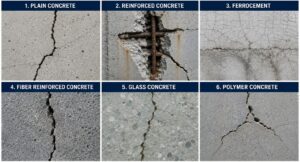
If you are interested in construction, you probably know that there are different types of concrete, and it is the main material that keeps buildings and structures upright. But few people know that behind the word “concrete” there are dozens of different types, each with its own specific qualities and applications. From the ordinary concrete we see in sidewalks to the high-tech polymer concrete used in the chemical industry. There are several main varieties that are particularly popular in modern construction.

Read more »
Concrete of the 21st century
Blog
Site Admin Y

Concrete of the 21st century

For more than a century, concrete has been the backbone of modern civilization. From bridges and highways to skyscrapers and dams, almost every major infrastructure system depends on it. For a long time, however, it was perceived as something purely functional: strong, inexpensive, but lacking innovation. Today, that perception is rapidly changing. With the development of materials science, nanotechnology, and digital construction methods, concrete is entering a new era.

Read more »

ASK FOR VISIT