Cracks in concrete, what causes them
Cracks in concrete are among the most common problems in the construction and operation of various structures. Whether it is a floor slab, foundation, wall, or load-bearing element, the appearance of cracks can be a sign of technological errors, improper loading, or natural material aging processes.
In many cases, small cracks do not pose an immediate risk to the strength of the structure. However, when they begin to expand or allow moisture penetration, the consequences can lead to serious damage and costly repairs. That is why it is important to understand the causes of their appearance in time and take appropriate corrective measures.
Cracks in concrete – main causes of their appearance
The appearance of cracks in concrete can be the result of various factors. Some of them occur during pouring, while others become visible after years of service.
Most often, the problem is related to concrete shrinkage during drying, temperature differences, improper construction execution, or excessive loads. Moisture, freezing and thawing cycles, as well as insufficient maintenance of concrete surfaces, also play a role.
• Concrete shrinkage during curing
• Temperature changes and atmospheric influences
• Structural errors and overloading
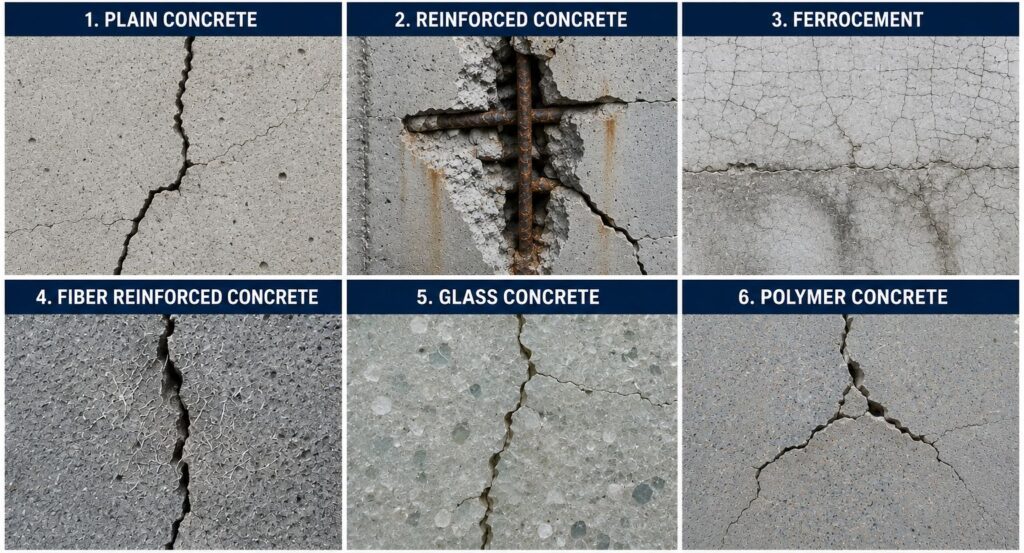
Cracks in plain concrete
Plain concrete is widely used for pavements, platforms, foundations, and other non-load-bearing or lightly loaded elements. Since it lacks reinforcement to absorb stresses, it is more susceptible to crack formation.
Most defects occur due to uneven drying, excessively rapid water evaporation, or insufficient layer thickness. During temperature fluctuations, the material expands and contracts, further increasing the risk of cracking.
• Shrinkage cracks after pouring
• Surface cracks caused by drying
• Cracking due to temperature differences
Cracks in reinforced concrete
Reinforced concrete combines the strength of concrete with the durability of steel reinforcement. Nevertheless, various types of cracks can also appear in this material.
A common cause is reinforcement corrosion. When water penetrates the structure, the steel begins to rust and increase in volume. This creates internal stress that leads to splitting of the concrete cover. Cracks may also occur due to improper design or excessive loading.
• Reinforcement corrosion
• Structural overloading
• Insufficient concrete cover
Cracks in ferrocement
Ferrocement is a thin-walled structure reinforced with fine steel mesh. The material is lightweight and strong but sensitive to improper execution.
When the reinforcement mesh is not adequately covered, moisture quickly reaches the metal and creates conditions for corrosion. As a result, numerous small surface cracks may appear and gradually expand.
• Corrosion of steel meshes
• Insufficient cover thickness
• Localized structural stresses
Cracks in fiber reinforced concrete
Fiber reinforced concrete contains special fibers that improve its resistance to cracking. However, problems may arise due to improper dosing or uneven distribution of the fibers.
When the technology is not properly followed, some areas remain less reinforced and local stresses develop. This leads to crack formation, especially under dynamic loads.
• Uneven fiber distribution
• Mixing errors
• High mechanical loads
Cracks in glass concrete
Glass concrete is a modern material in which glass fibers or additives are used to improve certain characteristics. It offers good durability but is sensitive to sudden temperature changes.
Improper use may lead to the formation of microcracks that gradually expand under the influence of the external environment. Areas exposed to large temperature fluctuations are particularly vulnerable.
• Thermal stresses
• Microcracks caused by operation
• External atmospheric influences
Cracks in polymer concrete
Polymer concrete contains polymer binders instead of part of the traditional cement. The material is resistant to chemical influences and has high mechanical strength.
Cracking may occur due to an incorrect ratio between the components or exposure to significant temperature fluctuations. In some cases, the cause is also the aging of the polymer components.
• Improper mixing of components
• Thermal deformations
• Material aging
How cracks in plain concrete are repaired
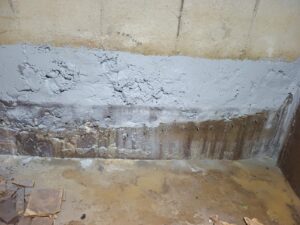
The repair method depends on the size and depth of the damage. For small surface defects, filling with special repair compounds is often sufficient. More serious damage requires cleaning and restoration of the affected area.
Wide cracks are usually treated with crack repair resins that penetrate deep into the material and restore its integrity.
• Filling with repair mortars
• Use of crack repair resins
• Local restoration of damaged areas
How cracks in reinforced concrete are repaired
In reinforced concrete, the condition of the reinforcement must first be assessed. If corrosion is present, the affected areas are cleaned and treated with protective coatings.
One of the most effective technologies is concrete injection using epoxy or polyurethane systems. These materials fill voids and restore the load-bearing capacity of the structure.
• Cleaning corroded reinforcement
• Concrete injection with resins
• Application of protective coatings
How cracks in ferrocement are repaired
Repairing ferrocement structures requires careful inspection of the reinforcement meshes. If corrosion is present, the damaged sections are replaced or protected.
The cracks are then filled with suitable repair compounds and the protective layer is restored.
• Restoration of reinforcement meshes
• Filling the cracks
• Application of a new protective layer
How cracks in fiber reinforced concrete are repaired
In most cases, small defects can be repaired through concrete injection or by using specialized repair products.
It is important to determine the cause of the problem, as repeated loading may lead to new cracking.
• Concrete injection
• Sealing with crack repair resins
• Load control
How cracks in glass concrete are repaired
Glass concrete requires a delicate approach during repair work. Most often, fine injection materials are used, capable of penetrating microcracks without altering the material structure.
After the repair, it is recommended to apply additional protection against moisture and temperature fluctuations.
• Injection of fine resins
• Sealing microcracks
• Moisture-resistant protective coatings
How cracks in polymer concrete are repaired
Polymer concrete is usually repaired using compatible polymer systems that provide strong adhesion and high durability.
For deeper cracks, concrete injection with specialized materials is used to restore the integrity and performance characteristics of the structure.
• Polymer repair compounds
• Concrete injection
• Restoration of damaged areas
Conclusion
Cracks in concrete can occur in all types of concrete structures, whether they are made of plain concrete, reinforced concrete, ferrocement, fiber reinforced concrete, glass concrete, or polymer concrete. The causes are often related to shrinkage, temperature changes, structural errors, or the effects of moisture and loading.
Timely inspection and the correct choice of repair method are essential for preserving the strength and durability of the structure. The use of high-quality crack repair resins, professional concrete injection, and appropriate repair technologies allows effective restoration and prevention of future problems.