New type of concrete absorbs CO₂
New type of concrete absorbs CO₂ construction industry is facing environmental challenges that require technological changes to achieve carbon neutrality. A new type of concrete fundamentally changes the concept of sustainable urban planning, combining high mechanical strength with innovative ecological characteristics. By harnessing industrial emissions, international researchers are achieving a remarkable breakthrough in the fight against climate change and air pollution.
This innovative building material possesses the unique ability to actively capture and retain harmful gases from the surrounding atmosphere throughout its entire life cycle. Specialists are directing their scientific efforts toward transforming buildings into active elements that purify the urban environment. Every object built with similar technologies contributes directly to reducing the carbon footprint.
Technological features and chemical composition
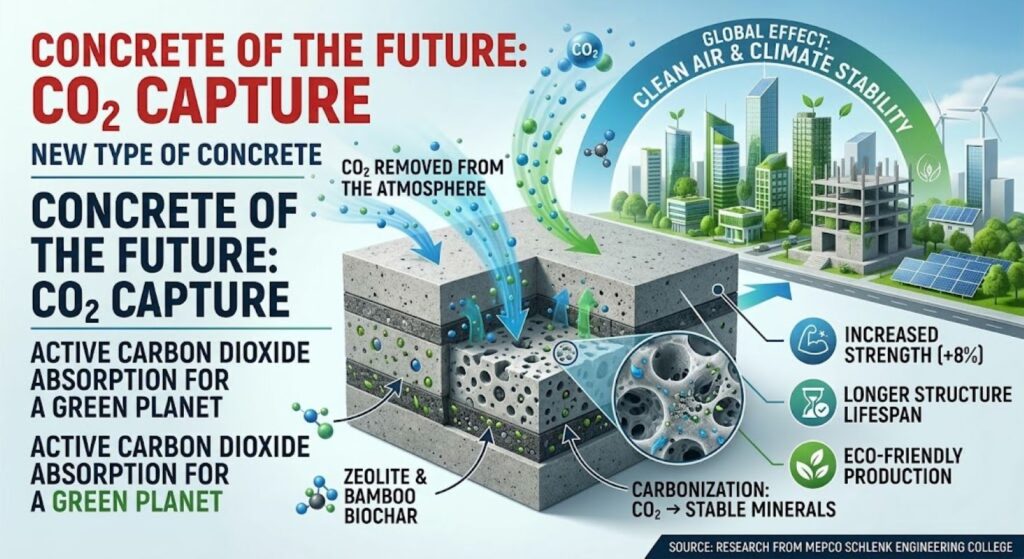
Engineers are developing complex formulas for the production of green building materials, utilizing the synergy between two specific components. The process relies on precisely selected raw materials, including porous zeolite and high-quality bamboo biochar, obtained through controlled pyrolysis.
The unique structure allows for efficient absorption of CO₂ even during the initial stages of the mixture’s hardening.
The optimal formula replaces 50% of the fine sand aggregate with zeolite and 1% of the cement with biochar.
Chemical reactions transform harmful emissions into stable mineral crystals of calcium carbonate within the structure.
Compressive strength increases by almost 8%, and splitting tensile strength by over 15%.
The discovery is the work of scientists from Mepco Schlenk Engineering College under the leadership of Dr. Srinivasan Revathi.
Ecological benefits and chemical mechanism of the reaction
Sustainable construction plays a key role in preserving natural resources and reducing emissions into the atmosphere. Reducing the carbon footprint is a main priority for modern engineers, as standard cement production generates nearly eight percent of global carbon emissions.
This new type of concrete offers durable and safe storage of captured carbon dioxide in the form of inert compounds.
Its application helps to easily meet strict global ecological norms and standards for green buildings.
Each unit of the optimized material captures up to 1.2 grams of carbon dioxide daily under normal urban conditions.
The microporous network facilitates the deep penetration of gas molecules, preventing their subsequent release back into the air.
Influence of microstructure on mineralization
The distribution of pores within the material matrix determines the degree of gas penetration in depth. Researchers use scanning electron microscopy to analyze changes in the composite’s internal architectonics after reacting with carbon dioxide.
Pores with nanometric dimensions provide a high specific surface area for the binding to occur.
The carbonization process fills microscopic cracks and makes the concrete structure significantly denser.
Bamboo biochar acts as an internal reservoir for moisture, aiding the prolonged hydration of the cement paste.
The mineralized carbon remains locked for centuries, without danger of degradation under standard climate changes.
Application in modern infrastructure construction
Large-scale engineering projects require reliable, durable, and sustainable construction materials over time. The scientific team successfully integrates ecological mixtures into various elements of modern urban infrastructure.
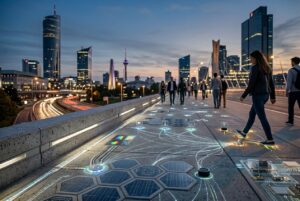
The construction of pedestrian zones, road pavements, and underground pipelines becomes significantly more eco-friendly.
The porous network creates an ideal environment for capturing gases in areas with intense automobile traffic.
Long-term protection of building elements is guaranteed through professional services for leak stopping and waterproofing.
Such innovative solutions transform the appearance and ecological balance of modern megacities.
Resistance to aggressive external influences
Resistance to chemical attacks is crucial for the operational lifespan of critical infrastructure. The introduction of zeolite improves the concrete’s resistance against sulfates, chlorides, and freezing during the winter months.
Reduced capillary permeability prevents the entry of water and dissolved salts in depth.
Mineralized pores limit the corridors for the spread of aggressive chemical agents toward the reinforcement.
The material shows excellent results during freezing and thawing cycles in laboratory conditions.
Buildings retain their structural integrity even during prolonged exposure to industrial acidic environments.
Economic advantages and cost reduction
Investments in innovative materials bring long-term financial benefits to builders and investors. Reduced subsequent maintenance costs compensate for the initial expenses of implementing the new technology.
Increased mechanical durability minimizes the risk of premature structural defects appearing.
This new type of concrete optimizes the operating and repair costs of municipal and private buildings.
The depth of penetration and binding of carbon dioxide reaches 15 millimeters in just one week.
Opportunities for carbon credits and certification
The use of materials with a negative carbon footprint opens up new financial mechanisms for the construction sector. Projects can apply for international green certificates and offset credits.
Certification under systems like LEED and BREEAM becomes much more easily achievable for investors.
Capturing gases directly from the structure brings additional value through the sale of carbon savings.
Buildings with low carbon intensity attract preferential financing from international investment funds.
The market price of real estate increases thanks to the implemented ecological innovations.
Challenges for mass industrial production
Despite the enormous potential, the mass entry of the technology on an industrial scale requires time and investment. Production capacities must be adapted for precise dosing of natural additives.
Additional large-scale laboratory tests are needed under various temperature and humidity climatic conditions.
The standardization of production processes is mandatory for widespread industrial use in construction.
The accumulation of practical experience will allow broader absorption of CO₂ on a global scale.
Optimization of raw material supply chains
Ensuring consistent quality of zeolite and biochar requires the establishment of reliable raw material chains. Local sourcing of minerals reduces transport costs and delivery emissions.
Standardizing pyrolysis processes for bamboo ensures uniform carbon content across batches.
Geological surveys identify suitable zeolite deposits near large concrete plants.
Mixing automation prevents lumps and ensures a homogeneous pore distribution.
Partnerships with forestry enterprises provide a sustainable supply of bamboo biomass for production.
Future prospects for ecological construction materials
Scientific research in the sector has been continuing at an extremely rapid pace over the past few years. Collaborative work between academic institutions and the construction business yields excellent applied results.
Future generations will have access to fully carbon-neutral and self-purifying urban centers.
Even more efficient formulas for absorbing CO₂ directly during concrete production are being developed.
This new type of concrete will occupy a central place in modern design and architecture.
Integration with digital models and smart cities
The digitalization of construction through building information modeling allows precise calculation of absorption capacity. Monitoring sensors track the degree of carbonization in real time.
Digital twins of buildings simulate the carbon balance for the entire life cycle of the object.
Intelligent sensors measure moisture levels and gas concentrations inside walls.
Data on bound carbon is automatically recorded in decentralized registries for complete transparency.
Smart cities optimize the placement of new buildings relative to primary air flows and pollutants.
The role of innovation in natural resource conservation
The optimization of utilized raw materials drastically reduces the exploitation of natural sand and gravel quarries. The green economy requires a circular approach to every construction component and reuse.
The recycling of old concrete structures can be successfully combined with carbon capture.
Efficient absorption of CO₂ contributes directly to the development of the circular economy in the industry.
Every new type of concrete clearly proves that heavy industry can be ecologically compatible.
Global effect on reducing gas emissions
The mass deployment of the innovative composite on a global scale would have an exceptional effect on the atmosphere. The industry has the potential to transform from a major polluter into a giant carbon sink.
Annual emissions savings could reach billions of tons with a global replacement of conventional mixes.
Urban environments will function as artificial forests absorbing exhaust gases from transportation.
International climate agreements receive a powerful technical tool to achieve stated goals.
Close integration between science, standardization, and business guarantees a fast transition to an ecological future.
New type of concrete absorbs CO₂, conclusion: Modern scientific discoveries and innovative ecological materials are completely transforming the construction industry, steering it toward a greener, cleaner, and more sustainable future. Reducing harmful emissions into the air and improving infrastructural security are of key importance for the health of future generations. Ongoing cooperation between global science and practice guarantees long-lasting, safe, and reliable results for modern cities.
Follow us on FB as well.
If you are experiencing this problem in your home, office or garage, do not hesitate to contact us or request an inspection. 🙂
Follow us on FB.