Water leakage through a concrete joint – where does the water come from and why can the problem appear years after construction?
Water leakage through a concrete joint can occur in basements, underground garages, foundation walls, tanks and other reinforced concrete structures that are in constant or periodic contact with water. In many cases, the concrete itself appears sound and there are no large visible cracks. Nevertheless, a damp line, water droplets or even a continuous leak may appear on the wall. The cause is often the joint itself – the point where two sections of the structure meet or where a certain degree of movement between them is intended.
Joints are a necessary part of many concrete structures, and their presence does not in itself indicate a construction defect. A problem arises when a path is created through them that allows water to pass. The most common signs include:
- a damp line running along the joint;
- water droplets or small streams;
- a wet area between the wall and the floor slab;
- white mineral deposits on the concrete;
- periodic water ingress after heavy rainfall;
- increased leakage when groundwater levels are high.
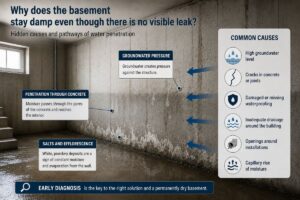
Leaks are particularly common in underground parts of buildings, where groundwater can exert pressure on the structure. Under sufficient pressure, water penetrates through weak points and may appear on the inside at a considerable distance from the original point of entry. Therefore, the visible damp spot does not always indicate where the leak actually begins.
What is a construction joint in concrete?
Large concrete structures can rarely be completed in a single continuous concrete pour. The work is divided into separate stages, and a construction joint is formed between the already hardened concrete and the next concrete pour. A typical example is the connection between a foundation slab and a basement wall – the slab is poured first, while the wall is constructed at a later stage. This creates a contact zone between concrete poured at two different times.
The risk of water penetration through such a zone may be associated with:
- insufficient concrete compaction;
- voids or porous areas around the joint;
- incorrectly installed or damaged waterproofing;
- defects in waterstop systems;
- subsequent cracking around the contact zone;
- constant or periodic external water pressure.
If this area is not adequately protected, the construction joint can become an easy pathway for water. The leak often appears as a continuous damp line along the boundary between the floor and the wall. Under higher water pressure, individual droplets, small streams or continuous water ingress may occur.
What is an expansion joint?
An expansion joint serves a different purpose. It is deliberately incorporated into the structure to allow movement between separate sections of a building or facility. Such movement can be caused by temperature changes, expansion and contraction of materials, deformation or other loads acting on the structure.
The very fact that the joint is designed to move makes its waterproofing more specific. A rigid material applied over an actively moving joint may gradually crack or separate. Therefore, repairs must take into account not only the presence of water but also the behaviour of the structure itself. Construction joints and expansion joints are not the same, and leaks through them should not necessarily be repaired using identical methods.
Why does water find its way through the joint?
Water follows the path of least resistance. Penetration through monolithic and properly constructed concrete can be relatively difficult, but the contact zone between two separately poured concrete sections represents a potentially weaker point. A very small channel, void or poorly compacted area can be enough for water penetration to begin.
When pressurised water is present on the outside, the process becomes even more pronounced. Water can gradually travel through existing capillary spaces and voids within the contact zone. This is why the size of the visible opening does not necessarily determine the severity of the problem – sometimes an almost invisible defect can allow a significant amount of water to pass through.
Why can water leakage through a concrete joint appear years later?
A building can remain dry for a long time, only for the problem to appear several years later. This does not necessarily mean that a new defect has developed. Conditions around the structure may have gradually changed, causing a weak area that previously allowed no visible water penetration to begin leaking.
Possible factors include:
- rising groundwater levels;
- prolonged or unusually heavy rainfall;
- snowmelt and severe water saturation of the soil;
- changes in drainage around the building;
- blocked or ineffective drainage systems;
- ageing or damage to the external waterproofing;
- movement and deformation of the structure.
Following prolonged rainfall or snowmelt, the amount of water in the soil surrounding an underground structure can increase significantly. If the water cannot drain away effectively, pressure against the structure rises. This is when an existing weak point may begin to allow water through, even though there may have been no visible signs of a problem for years.
Why isn’t the place where the water appears always where it enters?
This is particularly important with leaks in concrete. Water may penetrate through a particular point in the joint and then travel through internal voids, contact surfaces or microcracks. Only afterwards does it find a point from which it can emerge into the interior.
As a result, the property owner may see a damp spot in one location while the actual point of water entry may be to the side, higher up or lower down. This is one reason why simply patching the visible area often fails to provide a lasting solution. If the water path is not interrupted, it may simply find another way out.
Why doesn’t simply sealing the joint always solve the problem?
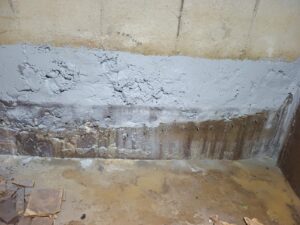
When there is an active leak, the first reaction is usually logical – seal the point from which the water is emerging. Cement-based compounds, fillers, silicone or other surface-applied materials may temporarily reduce the moisture, but this does not necessarily mean that the water path through the structure has been stopped.
Several problems can occur with surface sealing:
- the material closes the outlet but not the water path;
- water pressure remains behind the repaired area;
- moisture begins to appear immediately next to the repair;
- rigid material may crack as the joint moves;
- an initially dry area may create the impression that the problem has been solved even though water remains within the structure.
In such situations, the objective is not simply to conceal the point where the water emerges, but to interrupt its path through the structure itself.
How is the cause of water leakage through a concrete joint identified?
Before repairs begin, the type of defect responsible for the water ingress must be identified. The direction of the joint, damp areas, existing cracks and points of active water ingress are inspected. It is also important to determine whether the leak is constant or occurs only after heavy rainfall or under specific seasonal conditions.
The inspection should generally establish:
- the type of joint;
- the direction and approximate area of water penetration;
- whether there is an active leak at the time of inspection;
- whether additional cracks are present;
- whether there are signs of pressurised water;
- whether the structure moves in the area of the defect;
- what access is available to the affected area.
This diagnosis determines the appropriate repair method. A small localised leak through a construction joint may require a different solution from a long expansion joint that is leaking while continuing to accommodate structural movement.
How is an active leak stopped by injection?
One of the methods used to repair leaks through concrete joints is pressure injection. Holes are drilled into the structure and fitted with specialised injection packers. A suitable material is then injected through them under controlled pressure towards the joint and the channels through which the water is travelling.
The typical process includes:
- identifying the joint line and the leaking area;
- drilling holes at appropriate locations;
- installing injection packers;
- injecting the selected material;
- gradually treating the affected area;
- monitoring material penetration and the stopping of the water;
- removing the packers and sealing the holes after completion of the repair.
This is what distinguishes the method from a simple surface repair. The aim is for the material to penetrate deep into the affected area and fill or interrupt the pathways through which the water is travelling.
Different injection materials may be used depending on the specific situation. Polyurethane resins are widely used for leaks in concrete, while other injection systems are suitable for particular applications. The choice should not be based solely on which material can “stop water”. The width and type of joint, the presence of an active leak, water pressure and potential structural movement must all be taken into account.
What happens to the injection resin inside the joint?
This is the part of the process that the property owner usually cannot see. The material is introduced through the packers and penetrates accessible voids and channels around the defect. With some polyurethane systems, contact with water triggers a reaction that causes the material to expand. This allows spaces through which water has previously travelled to be filled.
Injection is generally carried out in a controlled manner through individual points so that the material reaches the required area. The exact positioning of the holes, the pressure applied and the material used depend on the specific structure and the condition of the joint.
Can the leak be stopped from the inside?
In certain cases – yes. This is one of the major practical advantages of injection technologies for underground structures. Consider a basement foundation wall with several metres of soil behind it. Reaching the exterior side may require excavation around the building, removal of paving or landscaping, or work in an area that is practically inaccessible.
Under suitable conditions, injection allows the affected area to be reached from the accessible interior side of the structure. This can be particularly important for:
- underground garages;
- basements and cellars;
- foundation walls;
- tunnels and underground structures;
- tanks;
- structures where the exterior side is inaccessible or excavation would be difficult.
However, this does not mean that every leak can automatically be repaired in this way. Before selecting a repair method, the structure, the cause of the water ingress and the actual path of the water must be established.
Should you wait until the leak becomes serious?
It is not advisable. The presence of water indicates that a pathway through the structure already exists. Even if the amount of water is currently small, conditions may change after the next period of heavy rainfall or a rise in groundwater levels.
Prolonged moisture exposure can lead to:
- persistently high humidity inside the room;
- mould growth;
- deterioration or detachment of plaster;
- damage to flooring and wall finishes;
- mineral deposits on surfaces;
- unfavourable conditions for materials and equipment stored in the affected area.
It is therefore better to identify the cause while the problem is still localised rather than waiting for substantial water ingress to occur.
Injection technologies are among the established methods for repairing and protecting concrete structures and are also covered in the technical resources of the International Concrete Repair Institute (ICRI).
Water leakage through a joint is a problem within the structure
When water penetrates through a concrete joint, the visible damp patch is only the end result. The actual problem lies in the pathway that the water has found through the structure. This is why a successful repair begins with correctly identifying the type of joint and the cause of the water ingress.
Only then can an appropriate method for stopping the leak be selected. For construction and expansion joints, injection technologies allow the material to reach the affected area itself rather than treating only the visible surface. This is the essential difference between temporarily concealing a damp area and carrying out a repair that addresses the cause of the leak.
If you are experiencing this problem in your home, office or garage, do not hesitate to contact us or request an inspection. 🙂
Follow us on FB.