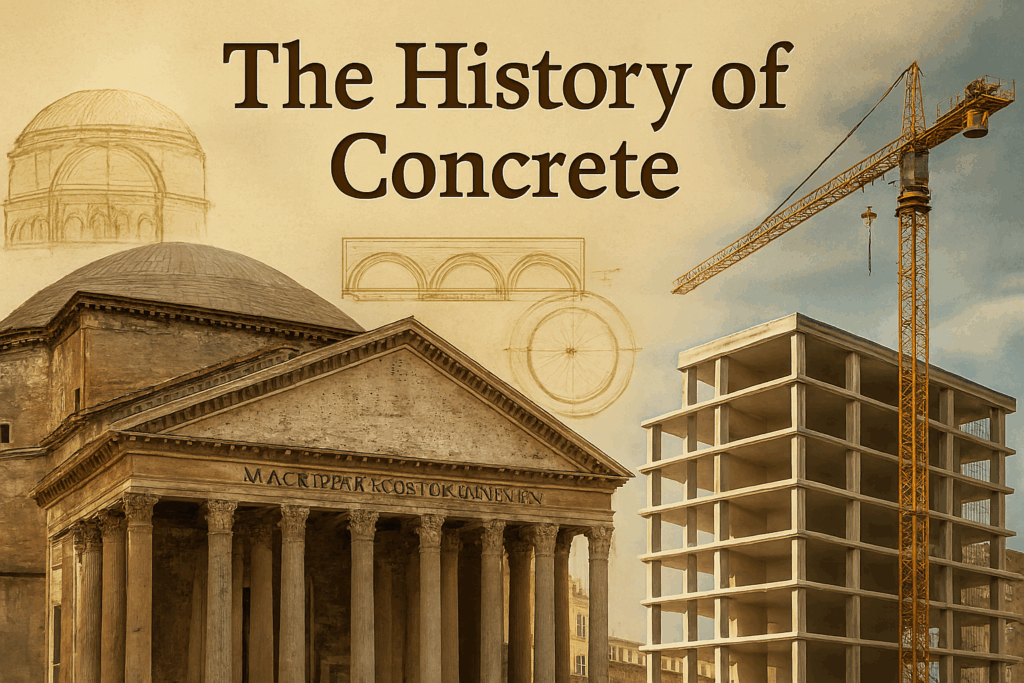
The History of Concrete: How It Was Created, by Whom, and Why It Changed the World
The history of concrete is the history of one of the most important building materials ever used by mankind. Although often seen as something ordinary and gray, its story is anything but boring. It’s a material that has survived millennia, revolutions, and scientific discoveries to become the foundation of modern infrastructure. This article will trace the origins of concrete, who created it, how it developed over the centuries, and why it remains indispensable today.
The Origins of Concrete: The First Steps in Antiquity
The first forms of concrete-like materials appeared as far back as prehistoric times. Archaeological finds from around 6500 BC in what is now Jordan and Syria show that people used mixtures of limestone and water to build homes and floors. These early construction techniques were primitive but demonstrate an intuitive understanding of the binding properties of lime.
Around 3000 BC, the Egyptians began using gypsum and lime as binding agents in the construction of the pyramids. While they didn’t use concrete in the modern sense, they demonstrated a knowledge of the chemical reactions between minerals and water that create solid structures.
In the 2nd century BC, the Nabataeans, an ancient Arab people who lived in what is now Jordan, began using hydraulic lime concrete. This type of concrete hardens upon contact with water and was used to build cisterns, canals, and water supply systems that functioned for centuries.
The Roman Revolution: Concrete as an Architectural Tool
The real breakthrough in the history of concrete came with Ancient Rome. The Romans perfected the technology and began to use concrete on a massive scale in the construction of public buildings, aqueducts, bridges, and ports. They created a material called opus caementicium—a mixture of lime, water, sand, and volcanic ash known as pozzolana.
Pozzolana, mined from the area around Mount Vesuvius, gave the concrete unique properties: water resistance, durability, and the ability to harden even underwater. This allowed the Romans to build ports and marine structures that have withstood time and saltwater.
One of the most impressive examples of Roman concrete is the Pantheon in Rome, built around 126 AD. Its dome, with a diameter of 43.3 meters, is the largest unreinforced concrete dome in the world and has survived for over 1,900 years. The Romans used different aggregates in the mixture—lighter materials at the top of the dome and heavier ones at the base—which shows exceptional engineering thought.
Medieval Decline and the Revival of Concrete
After the fall of the Roman Empire in the 5th century, the knowledge of concrete was almost completely lost. During the Middle Ages, construction was based primarily on stone, wood, and clay. Concrete disappeared from architectural practice for more than a thousand years.
It wasn’t until the 18th century that new experiments with hydraulic lime and binding agents began. In 1756, the British engineer John Smeaton used hydraulic lime to build a lighthouse in Cornwall, England. This is considered the first modern application of concrete in Europe since antiquity.
Joseph Aspdin and the Creation of Portland Cement
In 1824, the Englishman Joseph Aspdin patented Portland cement—a material resembling the stone from the Isle of Portland. He obtained this cement by calcining a mixture of limestone and clay at a high temperature, then grinding it into a fine powder. This discovery laid the foundations for modern concrete.
Portland cement is distinguished by its high strength, rapid hardening, and resistance to weathering. It quickly found application in the construction of bridges, canals, buildings, and roads in industrializing Europe and North America.
20th-Century Development: Reinforced Concrete and Global Expansion
Concrete underwent significant improvements in the 19th and 20th centuries. In 1849, the French gardener Joseph Monier patented reinforced concrete—a combination of concrete and steel rods that increases the material’s tensile strength. This discovery led to the creation of skyscrapers, bridges, and large-scale infrastructure projects.
In the 20th century, concrete became the main material for urbanization. Highways, dams, airports, tunnels, and residential complexes were built. New technologies were introduced, such as pre-stressed concrete, self-compacting concrete, and additives to improve durability.
Modern Innovations and Sustainability
Today, concrete continues to evolve. Researchers are creating self-healing concrete that uses bacteria to fill cracks. Translucent concrete, created by embedding optical fibers, allows light to pass through walls. Carbon-neutral concrete aims to reduce the CO₂ emissions associated with cement production.
Modern engineers and architects use concrete not only for its strength but also for its aesthetics. It has become a means of expression in modern architecture—from minimalist facades to artistic installations.
Conclusion
The history of concrete is the history of human progress. From primitive mixtures in antiquity to high-tech formulas in the 21st century, concrete is a material that builds civilizations. It is a testament to engineering ingenuity, adaptability, and the pursuit of a sustainable future.
When we look around us—from the roads we travel on to the buildings we live in—we see not just concrete, but a thousand-year history embedded in the foundations of our world.