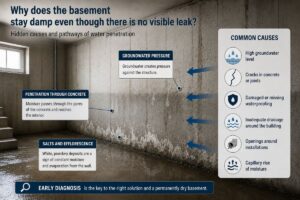
How moisture affects concrete

How moisture affects concrete

One of the most critical factors for strength and durability

Moisture plays a vital role in concrete, which is a fundamental material in modern construction, used in buildings, bridges, roads, and infrastructure. Despite its apparent strength, concrete is sensitive to moisture—both during curing and throughout its service life. Understanding how moisture affects concrete is essential for achieving long-lasting and safe structures.

Moisture in the hydration process

Hydration is the chemical reaction in which cement reacts with water to form a crystalline structure that gives concrete its strength. This process begins immediately after mixing and continues for days or even weeks.

  • If moisture is insufficient, hydration remains incomplete, leading to lower strength and a brittle structure

  • Excess water in the mix can create a porous structure that reduces surface durability

  • Controlled moisture retention (known as curing) during the first 7–14 days after placement is critical for achieving optimal mechanical properties

Water-cement ratio (W/C ratio)

The water-cement ratio is a key parameter that determines concrete quality. It represents the proportion of water to cement in the mix.

  • The optimal W/C ratio is between 0.40 and 0.50 for structural concrete

  • When W/C > 0.60, porosity increases, leading to lower strength and higher permeability

  • When W/C < 0.35, the concrete becomes difficult to work with and may result in cold joints and uneven compaction

Moisture from the environment and its impact

Once hardened, concrete remains exposed to environmental influences such as rain, soil moisture, condensation, and temperature fluctuations. These factors can lead to serious structural problems, especially if the concrete is not well protected.

  • Water penetration through microcracks can reach the reinforcement, causing corrosion and weakening the structure

  • At low temperatures, water in the pores freezes, expands, and causes cracking and surface spalling

  • Cyclic freezing and thawing accelerates deterioration, especially in climates with sharp temperature changes

Capillary porosity and water permeability

Concrete is a porous material. Moisture penetrates through capillary channels formed due to excess water or insufficient compaction.

  • Capillary porosity is related to the microstructure of concrete; the finer the pores, the slower the water penetrates, but the longer it remains

  • Water permeability is measured using tests such as DIN 1048 or EN 12390-8, which determine the depth of water penetration under pressure

Practical measures:

  • Use of superplasticizers to reduce water without losing workability

  • Compaction through vibration and proper formwork

  • Addition of microsilica or fly ash to fill pores

Carbonation and chloride corrosion

Moisture carries aggressive chemicals such as carbon dioxide (CO₂) and chlorides, which can trigger destructive reactions in concrete.

  • Carbonation lowers the pH of concrete and leads to reinforcement corrosion

  • Chloride corrosion is especially dangerous in marine environments or when de-icing salts are used

Technical solutions:

  • Use of low-permeability concrete (e.g., with pozzolanic additives)

  • Protective coatings on reinforcement (epoxy, zinc)

  • Cathodic protection for structures with high exposure

Freezing and thawing of concrete

Freeze-thaw cycles are especially damaging to water-saturated concrete. When water freezes, it expands by about 9%, creating internal stress.

  • The resistance factor is determined through tests such as ASTM C666

  • Air-entraining additives create microbubbles that act as buffers during water expansion

Engineering practices:

  • Use of air-entrained concrete in cold climate zones

  • Avoiding saturation before freezing conditions

  • Maintaining surfaces with hydrophobic coatings

Standards and regulatory requirements

Moisture’s impact on concrete is addressed in various construction standards:

  • EN 206: European standard for concrete, including exposure class classification (XC, XD, XF, etc.)

  • BDS EN 12390: Bulgarian standard for concrete testing, including permeability and strength

  • ACI 318: American standard defining requirements for corrosion and freeze-thaw resistance

Methods for moisture control and protection

To minimize the negative impact of moisture, various engineering and technological solutions are applied:

  • Adding waterproofing admixtures to the concrete mix

  • Applying protective coatings such as epoxy resins, silicone impregnations, or polyurethane membranes

  • Installing drainage systems around the structure

  • Using concrete with a low water-cement ratio

  • Conducting controlled curing using wet cloths, polyethylene sheets, or specialized curing compounds

How moisture affects concrete, conclusion

Moisture is a double-edged sword in the world of concrete—it is essential for the initial curing process, but can become a major threat to durability if not properly managed. An engineering approach to moisture must be systematic and careful, involving proper design, quality execution, and ongoing maintenance. Only then can concrete fulfill its role as a reliable and durable material in the long term.

Concrete crack repair with resins, how is it done 2
Blog
Site Admin Y

Concrete crack repair with resins, how is it done?

Concrete is a strong material, but over time even it begins to show signs of fatigue. Fine lines, splits, or deeper cracks appear, which often seem harmless, but can actually lead to serious problems. That is exactly why crack repair must be done on time and with the right technology. One of the most reliable methods today is the use of special crack resins, which penetrate deep inside and restore the strength of the structure.

Прочетете повече »
Types of concrete in construction
Blog
Site Admin Y

Types off concrete in buildings

If you are interested in construction, you probably know that there are different types of concrete, and it is the main material that keeps buildings and structures upright. But few people know that behind the word “concrete” there are dozens of different types, each with its own specific qualities and applications. From the ordinary concrete we see in sidewalks to the high-tech polymer concrete used in the chemical industry. There are several main varieties that are particularly popular in modern construction.

Прочетете повече »

ASK FOR VISIT