Intelligent concrete with sensors, the future is here
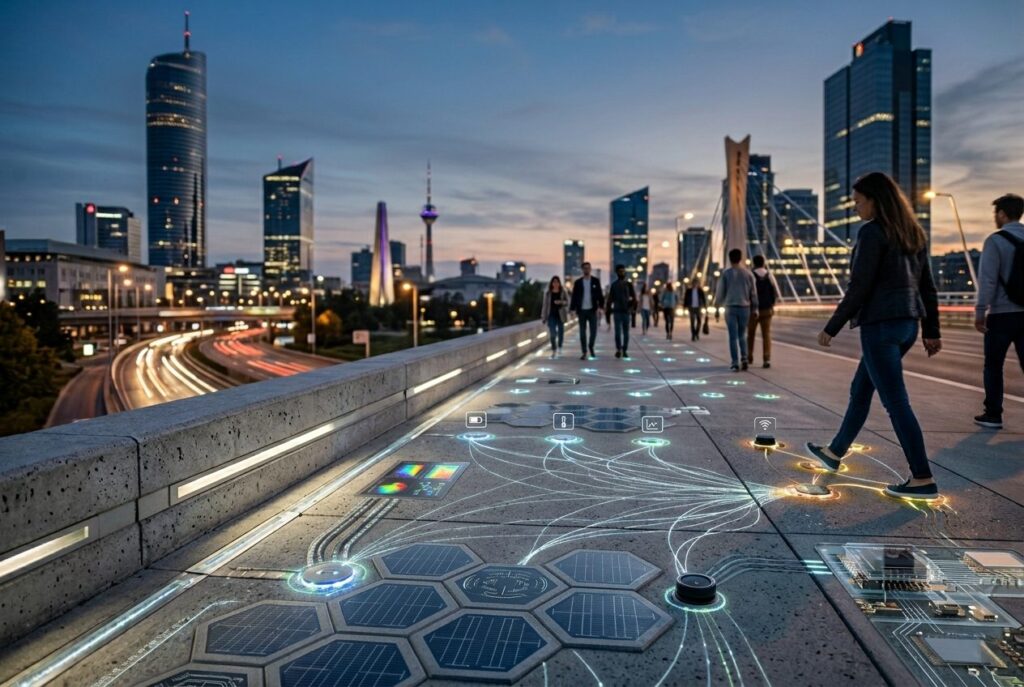
Intelligent concrete with sensors, when technologies change the rules globally. Probably we are all used to thinking of concrete as something hard, dead and insensitive. But imagine a material that itself feels when a crack appears. As well as when the tension becomes too great or where exactly in its thickness something is wrong. This is not science fiction, but a reality that is already entering construction. Intelligent concrete with sensors is a composite material. Which thanks to additives of metal fibers, graphite, carbon nanotubes or graphene. Thus the smart concrete can “feel” the tensions, deformations and cracks in itself.
This material combines the strength of ordinary concrete with the electronic properties of the added conductive particles. When the load changes, the fibers in the concrete with sensors shift slightly, which changes the electrical resistance of the entire mass. This change can be measured by external equipment and immediately signal a problem. Thus the concrete with sensors turns into one huge, wireless sensor that never stops working.
Self-sensing material: Intelligent concrete with sensors reacts to changes in its own structure.
Continuous monitoring: Once built, the concrete continuously sends data about its condition.
Durability: Unlike electronic sensors that are glued on the outside, intelligent concrete is part of the structure and cannot be easily damaged.
How does intelligent concrete work in practice?
The principle of operation is extremely interesting. Instead of embedding separate electronic sensors in the concrete, we change the material itself. These are the so-called “intrinsic” (inherent) monitoring systems, in which the concrete itself changes its electrical resistance when deformed or cracked. The network of conductive particles formed inside it (for example carbon fibers) breaks during microscopic changes, which is immediately recorded by a registering device.
In other words, when a micro crack appears, the conductive path is broken and the resistance jumps. When the load compresses the concrete, the fibers are pressed against each other and the resistance falls. These changes are so sensitive that they can detect cracking that is not yet visible to the naked eye. Thus the sensors in the concrete work at the molecular level to keep the security of buildings and bridges.
Change in resistance: The load changes the electrical resistance of the material.
Early warning: Intelligent concrete with sensors detects micro cracks before they become dangerous.
No external sensors: The entire concrete element works as a sensor, without the need for additional devices.
Intelligent concrete with sensors – application and advantages
Bridges and viaducts
Intelligent concrete with sensors is used more and more often in the construction of bridges and viaducts, because they are among the most loaded structures. The constant movement of heavy trucks, buses and cars creates vibrations and micro-loads, which over the years lead to material fatigue. Traditional inspection methods rely on visual inspections, which cannot find cracks hidden deep in the concrete. With the concrete with sensors, however, every appearance of a micro crack is immediately registered through a change in the electrical resistance.
Real-time traffic monitoring: The sensors in the concrete track how heavy the load from passing cars is and when it exceeds the design norms.
Early detection of cracks: Even the smallest cracks that are not yet visible to the naked eye are immediately detected and a signal for intervention is transmitted.
Extended structure life: Thanks to timely repairs, bridges with intelligent concrete can last decades longer than ordinary ones.
Reducing sudden closures: When the system gives a signal, specialists know exactly where the problem is and can fix it quickly, without closing the bridge for long.
Tunnels and metro
Tunnels and metro dynamics are subject to enormous pressure from the surrounding rock masses and soil. Over time, this pressure can lead to deformations, displacements and cracking of the concrete lining. Manual inspections in tunnels are difficult, dangerous and expensive. That is why the concrete with sensors (smart concrete) is the ideal solution for continuous monitoring of underground infrastructure.
Recording the pressure of rock masses: The sensors in the concrete register even minimal changes in the pressure on the tunnel walls, which can be a harbinger of collapse.
Monitoring deformations: At every terrain displacement, the intelligent concrete with sensors changes its resistance and immediately sends data to the control center.
Passenger safety: In changing metro dynamics, the system can find a problem in its infancy, before it threatens the movement of trains.
Reducing expensive inspections: Instead of sending teams into closed tunnels for inspection, data comes automatically from the concrete with sensors, which saves money and time.
High-rise buildings and skyscrapers
High-rise buildings and skyscrapers are subject to constant dynamic loading from wind, temperature differences and seismic effects. Over the years, these factors can lead to cracks in foundations and load-bearing walls that are invisible to the external observer. Intelligent concrete with sensors provides the opportunity for monitoring the building’s health through its entire life.
Monitoring the influence of wind: Sensors in the concrete track how high floors sway in strong winds and whether this creates excessive stress in the structure.
Registering seismic impacts: In an earthquake, the concrete with sensors shows which parts of the building have been damaged and need inspection, without requiring evacuation for days.
Preventing expensive accidents: Early detection of cracks in foundations or load-bearing columns allows for timely repairs, which are several times cheaper than restoration after a collapse.
Extending the life of the building: Thanks to constant monitoring, the intelligent concrete with sensors helps owners take informed decisions for maintenance and keep the value of their property.
Conclusion
Intelligent concrete with sensors is not just another innovation, but a true revolution in the way we build and maintain our infrastructure. It turns passive masses of concrete into active carriers of information that quietly warn us of danger, save us funds and most of all – protect human lives. Although it is not yet mass practice, the technology is rapidly developing, thanks to progress in nanomaterials and the decreasing prices of conductive additives.
The tendency is irreversible: the future of construction will be “alive”, connected and sensitive. It is expected in the coming years more and more bridges, tunnels and high-rise buildings to be built with intelligent concrete with sensors. Next time you pass on some big bridge, you might think – it may already be sending you data about its state, without even suspecting. This is the future that is already knocking on the door, and we are just starting to realize its huge potential for safety and sustainability.