Types of concrete in construction
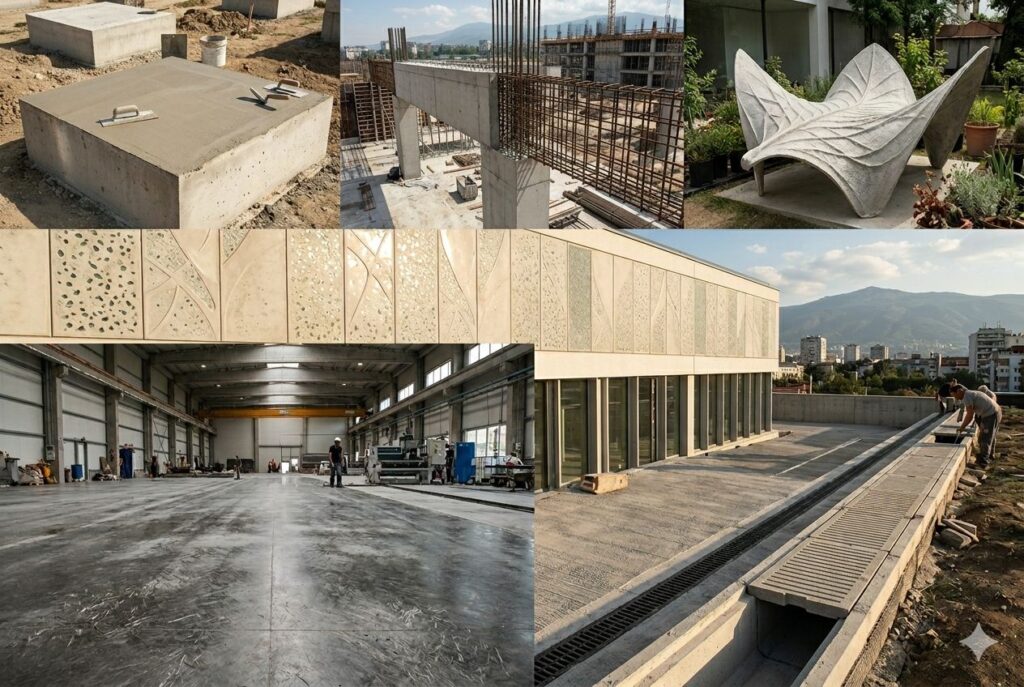
If you are interested in construction, you probably know that there are different types of concrete, and it is the main material that keeps buildings and structures upright. But few people know that behind the word “concrete” there are dozens of different types, each with its own specific qualities and applications. From the ordinary concrete we see in sidewalks to the high-tech polymer concrete used in the chemical industry. There are several main varieties that are particularly popular in modern construction.
In the following lines, we will look at six of them. We will see what they are used for, where they are applied, and what their strengths are. Whether you are a professional or just curious, this information will help you understand why buildings last so long and bridges do not collapse. We will get acquainted with ordinary concrete, reinforced concrete, ferrocement, fiber-reinforced concrete, glass concrete and polymer concrete.
Types of concrete in detail
Ordinary concrete
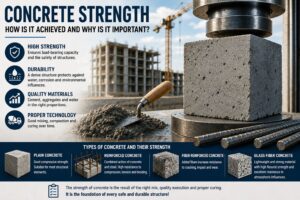
Ordinary concrete is the most common type. It is used where high tensile strength is not required, but compressive strength is important. Examples of this are foundations of small houses, sidewalks, floor screeds, stairs and interior walls. Its composition is relatively simple – cement, water, sand and aggregates in certain proportions.
Its advantages are low cost, easy preparation and good insulating properties. It can be poured into any shape and hardened outdoors. The disadvantage is that it is brittle when bent and cracks easily when the ground settles. Therefore, in more important structures it is always reinforced with rebar. At its core, ordinary concrete is still a basic material for many construction activities.
Low cost of materials and easy execution technology.
Good compressive strength, suitable for foundations and floors.
Can be poured into any shape and hardened outdoors.
Reinforced concrete
Reinforced concrete is perhaps the most important material in modern construction. It is a combination of ordinary concrete and steel reinforcement. The reinforcement (most often ribbed bars) is placed in the formwork before the concrete is poured. When the concrete hardens, the two materials work together. The concrete takes the compression, and the steel takes the tension.
This combination makes reinforced concrete ideal for beams, columns, slabs, bridges and high-rise buildings. Thanks to the steel, the structure can also withstand dynamic loads such as wind and earthquakes. The advantages are high strength, long life and fire resistance. The disadvantage is that it is heavier and requires special design. Reinforced concrete is indispensable for any major construction structure.
High strength in both compression and tension thanks to the reinforcement.
Resistant to fire and dynamic loads (wind, earthquake).
Used for foundations, beams, columns, bridges and high-rise buildings.
Ferrocement
Ferrocement is relatively unknown to the general public, but very valuable in specialized fields. It is a thin-walled material, composed of cement mortar (without coarse aggregates) and several layers of wire mesh. The result is extremely strong, yet thin and light elements. Ferrocement has high impact and bending resistance.
It is most often used for building boats, boat docks, water tanks, silos and roof panels. Its advantages are low weight and high strength, which makes it suitable for portable structures. Also, it can be bent and molded into complex shapes. Compared to reinforced concrete and ordinary concrete, ferrocement is more difficult to execute and requires a higher qualification of workers.
Extremely high flexural strength with minimal element weight.
Suitable for building boats, tanks, silos and roof panels.
Possibility of creating complex and curved shapes with thin walls.
Fiber-reinforced concrete
Fiber-reinforced concrete is an improvement on ordinary concrete by adding short fibers. These fibers can be steel, glass, polypropylene or carbon. They are evenly distributed in the mixture and help control cracks. In this way, fiber-reinforced concrete has much higher impact and wear resistance.
Its application includes industrial floors, road pavements, tunnel linings and seismic structures. Fiber-reinforced concrete sometimes completely replaces or complements the reinforcement. The advantages are reduced element thickness, faster installation and longer life. The disadvantage is the higher cost compared to ordinary concrete. With polypropylene fibers, better resistance to aggressive chemicals is also achieved.
The addition of fibers increases impact and crack resistance.
Suitable for industrial floors, road pavements and tunnel linings.
Sometimes allows reduction or complete replacement of traditional reinforcement.
Glass concrete
Glass concrete combines concrete and glass. It can be in the form of glass blocks that are laid like bricks, or as glass fibers reinforcing the concrete mixture. In the first case, translucent walls are obtained that let light through but provide thermal insulation. In the second case, glass concrete has improved mechanical properties.
Glass concrete is used for facades, partition walls, railings and decorative elements. It is resistant to moisture, fire and impact. The advantages are the visual effect and good insulating qualities. The disadvantage is that it is more expensive than ordinary concrete and requires special skills for installation. This material is preferred in architecture where a combination of strength and natural light is sought.
Lets in natural light, saving energy for lighting.
Resistant to moisture, fire and impact – suitable for facades and railings.
Possibility of incorporating glass fibers that reinforce the concrete.
Polymer concrete
Polymer concrete is the most modern of the types considered. Here the binding agent is not cement but a polymer (e.g., epoxy or polyester resin). The result is a material with exceptional resistance to chemicals, water and abrasion. Polymer concrete has no capillary porosity, which means it does not absorb moisture and does not deteriorate from freezing and thawing.
It is used in the chemical industry (floors, tanks, pipes), in machine building, as well as for repairing concrete structures. The advantages are very high strength, fast curing and long life. The disadvantage is the significantly higher cost and more complex preparation technology. Polymer concrete is used where other concretes would quickly be damaged.
Extremely resistant to acids, bases, salts and petroleum products.
Has no capillary porosity, making it impervious to water and moisture.
Suitable for chemical floors, tanks, pipes and repair of damaged concrete structures.
Conclusion on types of concrete
Each type of concrete has its place in construction. Ordinary concrete is ideal for small projects and foundations. Reinforced concrete is indispensable for high-rise buildings and bridges. Ferrocement is used for light but strong structures such as boats and tanks. Fiber-reinforced concrete improves impact resistance and is applied in industrial floors and tunnels. Glass concrete brings light and aesthetics to architecture. And polymer concrete is the solution for the most aggressive chemical environments.
The choice of the right material depends on the requirements for strength, weight, cost and operating conditions. The good news is that with these six types we can cover almost any need – from a small park bench to a giant bridge or industrial tank. Construction would be unthinkable without them, and understanding them helps architects, entrepreneurs and ordinary people who want to know why their homes are safe.