Resins for concrete injection
Resins for concrete injection play a key role in restoring structural strength, stopping leaks and extending the lifespan of various structures. They work quietly but effectively, filling fine cracks, stabilizing crumbling areas and preventing more serious deformations. Their foundation lies in the idea of precise restoration – without demolition, without unnecessary repairs and with maximum efficiency.
The resins used for this type of work are designed to react in a targeted way. Some expand when they come into contact with water, others harden firmly and densely, and a third group remains elastic even after years. This variety allows specialists to choose the most suitable solution depending on the specific problem. This way the repair remains durable, and the risk of recurring damage is minimized.
When applied correctly, concrete injection resins can prevent even major structural damage. This is why understanding the different types, their properties and their intended use is important not only for professionals but for anyone facing repair activities. Good judgment is crucial, and a high-quality resin often means a saved structure, reduced costs and long-term stability.
Types of resins for concrete injection
The resins used in concrete injection come in several main types, each created for a different situation. The most common ones are polyurethane, epoxy and acrylate resins. They differ in reaction speed, durability after curing and the way they interact with moisture.
Polyurethane resins are most often used for sealing leaks, as they expand when in contact with water. Epoxy resins, on the other hand, are known for their hardness and ability to restore the load-bearing strength of the structure. Acrylate resins remain more elastic and are used where flexibility and strong adhesion are required.
- Polyurethane resins for stopping active leaks
- Epoxy resins for structural restoration
- Acrylate resins for flexible filling and deep penetration
When each type of resin is used
Different resins are used depending on the nature of the problem. Polyurethane resins are indispensable when there is active water flow through the concrete. They react quickly and form a dense barrier that stops moisture. Epoxy resins are used when the goal is not only filling but also structural strengthening of cracked areas. This makes them preferred for static cracks.
Acrylate resins are suitable for more delicate situations where it is important for the material to remain elastic. They penetrate very deeply into the concrete structure, which makes them effective for capillary cracks and more precise repairs.
- Polyurethane resins – for wet areas and active leaks
- Epoxy resins – for firm and solid restoration
- Acrylate resins – for fine and elastic fillings
When concrete injection is necessary
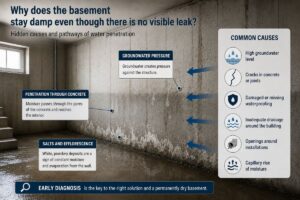
Concrete injection is required when there are cracks, leaks or weakened areas that threaten the stability of the structure. Often this is the only solution that allows repair without demolition. Moisture, subsidence of the foundation or material aging can lead to problems that require immediate intervention.
This procedure is also applied when capillary moisture appears, when there are voids in the concrete or when there is a risk of delamination. Proper injection prevents further damage and allows the structure to maintain its long-term strength.
- For cracks in load-bearing elements
- For leaks through concrete walls or floor slabs
- For capillary moisture or voids in the structure
Conclusion
Resins for concrete injection are an essential part of modern repair practices. They allow precise restoration, moisture protection and strengthening of structures without the need for demolition. Understanding the different types of resins and their applications makes it possible to address problems in time and in the most efficient way. The right choice means a stronger structure and significantly longer service life.