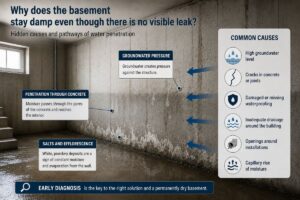
Moisture and water protection of concrete foundations
Concrete is a primary structural material used in almost all types of buildings and infrastructure projects. Its strength, compressive resistance, and durability make it a preferred choice for foundations, slabs, footings, and walls. However, concrete has a porous structure that makes it vulnerable to water and moisture penetration. Without adequate protection, moisture can compromise its mechanical properties, cause reinforcement corrosion, and create conditions for mold and mildew development.
Protecting the concrete foundation from moisture and water is critically important not only for preserving structural integrity but also for ensuring a healthy indoor environment. Water penetrating the foundation can rise capillarily into walls and floors, causing stains, odors, and damage to finishing materials. Additionally, moisture reduces the thermal insulation properties of the structure, leading to increased energy costs and discomfort for occupants.
In this article, we will examine the main causes of water penetration into concrete foundations, the potential damage it can cause, and the most effective protection methods. The goal is to provide a practical guide for architects, builders, and property owners who want to ensure the durability and safety of their structures.
Causes of water penetration into concrete foundations
Water can reach the concrete foundation through various paths, especially when there is a lack of adequate protection or the structure is exposed to adverse weather conditions. Soil moisture, rainwater, and condensation are just some of the factors that can compromise the integrity of concrete. Understanding these mechanisms is the first step toward effective prevention and long-term protection.
Capillary rise from the soil
Rain and surface water in the absence of drainage
Condensation from internal temperature differences
Cracking of concrete due to thermal or mechanical stress
Damage from moisture to concrete foundations
Water penetration into concrete foundations is not just a cosmetic issue—it can lead to serious structural and health consequences. Moisture accelerates degradation processes, weakens the load-bearing capacity of the structure, and creates conditions for biological contamination. Moreover, it can affect the building’s energy efficiency and increase maintenance costs.
Structural damage
When water penetrates the concrete foundation, it can cause physical changes in the material’s structure. This leads to the expansion of existing cracks, the formation of new ones, and gradual surface deterioration. Over time, these defects can compromise the stability of the entire structure.
Expansion of cracks and formation of new ones
Loss of strength and compressive resistance
Layer separation and surface flaking
Reinforcement corrosion
Reinforcement embedded in concrete is intended to provide additional strength and durability. But when water reaches the steel elements, it causes corrosion, which increases the volume of the metal and creates internal stress. This leads to cracking and destruction of the concrete around the reinforcement.
Water reaches the steel reinforcement
Rusting begins, increasing the volume of the metal
This leads to internal destruction of the concrete
Mold and mildew formation
A moist environment is ideal for the development of microorganisms such as mold and mildew. They not only damage building materials but also pose a health risk to occupants. Mold can spread into interior spaces, causing allergies, respiratory problems, and unpleasant odors.
Moisture creates a favorable environment for microorganisms
Mold can spread into interior spaces
Negatively affects health and air quality
Loss of thermal insulation
Concrete, when dry, has certain thermal insulation properties. But in the presence of moisture, these properties deteriorate significantly. Wet concrete allows more cold and heat to pass through, leading to increased heating and cooling costs and reduced comfort in rooms.
Wet concrete has lower insulation properties
Energy consumption for heating increases
Leads to discomfort and higher bills
Methods for moisture and water protection
To ensure the durability of the concrete foundation, targeted moisture protection measures must be applied. Modern technologies offer various solutions that can be adapted according to the type of structure, climate conditions, and load level. Combining different methods provides the best efficiency and long-term resistance.
Waterproofing membranes
These membranes act as a physical barrier between the concrete and the external environment. They are applied to the surface of the foundation and prevent direct contact with water. The choice of material—bitumen, PVC, or polyethylene—depends on the specific conditions and project requirements.
Applied to the outer or inner side of the foundation
Can be bitumen, PVC, or polyethylene
Protect against direct contact with water
Hydrophobic impregnation agents
Impregnating agents penetrate deep into the pores of the concrete and create a water-repellent layer. They do not alter the surface appearance and preserve its vapor permeability. This makes them suitable for protecting facades, slabs, and vertical elements.
Penetrate into concrete pores and repel water
Preserve the material’s vapor permeability
Suitable for vertical and horizontal surfaces
Cementitious waterproofing
Cement mixtures with waterproofing additives are applied as plaster or filler on the concrete foundation. They form a dense, water-impermeable layer that is resistant to mechanical impacts and weather conditions. Suitable for basements, tanks, and underground structures.
Applied as plaster or filler
Create a water-impermeable layer
Resistant to mechanical impacts
Drainage systems
Drainage is a key element in combating groundwater. Properly constructed drainage systems divert water away from the foundation, preventing its accumulation. This includes the use of perforated pipes, gravel, and geotextile layers.
Divert water away from the foundation
Include perforated pipes, gravel, and geotextile
Prevent accumulation of groundwater
Moisture and water protection of concrete foundations, conclusion
Moisture and water protection of concrete foundations is not just a recommendation, it is a necessity for every sustainable and safe structure. Combining waterproofing technologies, drainage, and internal environment control ensures durability, a healthy atmosphere, and resource savings. The right choice of methods depends on the specific terrain conditions, building type, and expected load.