Concrete in the 21st Century: From “Gray Stone” to High-Tech Innovation
Concrete of the 21st century, for more than a century, concrete has been the backbone of modern civilization. From bridges and highways to skyscrapers and dams, almost every major infrastructure system depends on it. For a long time, however, it was perceived as something purely functional: strong, inexpensive, but lacking innovation.
Today, that perception is rapidly changing. With the development of materials science, nanotechnology, and digital construction methods, concrete is entering a new era. It is no longer just a mixture of cement, water, sand, and gravel. Modern concrete can heal itself, absorb carbon dioxide, communicate through sensors, and even participate in energy systems.
In the world of “smart materials,” concrete is transforming from a passive structural element into an active part of infrastructure. Below is a closer look at some of the most important technologies reshaping the construction industry.
1. Concrete of the 21st century: Self-healing “bio-concrete”: the end of constant repairs?
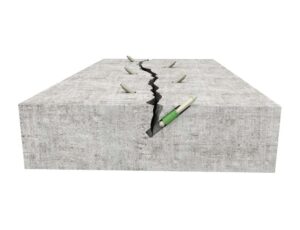
One of the biggest problems in concrete structures is microcracking. These cracks appear due to temperature changes, mechanical stress, material shrinkage, or water infiltration. Although they may seem insignificant, over time they allow moisture and oxygen to penetrate the structure, leading to corrosion of the steel reinforcement and serious structural damage.
The maintenance of infrastructure such as bridges, tunnels, and dams costs billions of euros every year largely because of this process.
How the technology works
Self-healing concrete uses a microbiological approach. Special microcapsules containing bacteria such as Bacillus pseudofirmus or Bacillus sphaericus are added to the concrete mixture. These microorganisms can remain dormant for decades-sometimes even more than 200 years.
Along with the bacteria, a nutrient source—usually calcium lactate—is also included in the capsules.
The self-healing process
A crack appears in the structure.
Water penetrates the crack.
The water activates the bacteria.
The bacteria begin to consume the calcium lactate.
As a by-product, calcium carbonate (limestone) is formed.
This mineral gradually fills the crack and seals it completely within a few weeks.
Advantages
significantly longer lifespan of structures
reduced repair costs
better resistance to corrosion
fewer infrastructure disruptions
This technology is already being tested in bridges, parking structures, and tunnels across Europe and Asia.
2. Concrete of the 21st century: 3D-printed concrete: a revolution in construction speed
3D printing is gradually transforming the way entire buildings are constructed. The technology, known as Contour Crafting, uses large robotic printers that extrude a specialized concrete mixture layer by layer.
Instead of traditional processes involving formwork, manual labor, and multiple pouring stages, the machine builds the walls directly from a digital model.
Key advantages
Minimal waste
Material is placed only where it is structurally necessary.
Reduced labor costs
Much of the formwork work is eliminated, potentially reducing labor costs by up to 50%.
Construction speed
Some experimental projects show that a small house can be printed in less than 48 hours.
Architectural freedom
3D printing allows the creation of complex geometries—organic shapes, curved walls, and optimized structural forms.
Real-world applications
The technology is already used for:
In the future, it may become a primary method for building fast and affordable urban neighborhoods.
3. Concrete of the 21st century: Graphene concrete: the supermaterial of the future
Graphene is one of the most discussed materials in modern science. It is a single-atom-thick layer of carbon arranged in a hexagonal lattice. Despite its minimal thickness, it is extremely strong and possesses exceptional electrical and thermal properties.
Adding small quantities of graphene particles to a concrete mixture can significantly improve the material’s performance.
Key improvements
Higher mechanical strength
Studies show increases in compressive strength of over 100–140%.
Lower porosity
Graphene improves the microstructure of concrete and reduces water penetration.
Longer reinforcement lifespan
Lower permeability means less risk of corrosion.
Environmental benefits
Stronger concrete means less material is required for the same structural performance. This leads to:
4. Concrete of the 21st century: Decarbonization and “green” concrete
The cement industry is responsible for approximately 7–8% of global carbon dioxide emissions. As a result, the construction sector faces increasing pressure to reduce its environmental footprint.
CarbonCure technology
One of the most promising solutions is CarbonCure technology. In this process, captured industrial CO₂ is injected into the concrete during mixing.
The gas chemically reacts with calcium compounds and turns into a stable mineral—calcium carbonate.
This creates a double benefit:
Recycled aggregates
Another important approach is the use of recycled construction materials, such as:
crushed old concrete
recycled glass
industrial by-products
metallurgical slag
This practice, often called Urban Mining, reduces the need for new quarries while decreasing construction waste.
5.Concrete of the 21st century: Smart concrete with embedded sensors
Modern infrastructure is increasingly becoming part of the Internet of Things (IoT). Concrete can be equipped with miniature sensors that continuously monitor the condition of the structure.
What these sensors measure
temperature
humidity
mechanical stress
microcracks
chemical changes
The data is transmitted in real time to engineering monitoring systems.
Practical applications
This technology is especially valuable for:
Engineers can receive early warnings about potential structural issues and take action before serious damage occurs.
6. Electrically conductive concrete: the end of icy roads
Another fascinating innovation is electrically conductive concrete. It is created by adding carbon fibers, graphite powder, or metal particles to the mixture.
These additives allow the concrete to conduct small amounts of electrical current.
Applications
Snow-melting systems
Roads, bridges, and airport runways can be gently heated to prevent the formation of ice.
This eliminates the need for:
road salt
chemical de-icing agents
mechanical snow removal
Smart infrastructure
In the future, such pavements could enable:
wireless charging for electric vehicles
integrated energy systems in smart cities
connection with solar energy networks
The economic aspect: is the future expensive?
At first glance, innovative concrete technologies may seem more expensive. Depending on the specific technology, the price may be 10–30% higher than conventional concrete.
However, when the entire lifecycle of a structure is considered, the picture changes significantly.
Key economic benefits
Fewer repairs
Self-healing materials and more durable mixtures reduce maintenance needs.
Longer structural lifespan
Instead of lasting 50–60 years, some modern concrete systems can endure for more than 100 years.
Higher energy efficiency
Improved thermal properties and integration with energy technologies.
Conclusion
Concrete is no longer just the “gray background” of modern architecture. Thanks to biotechnology, nanomaterials, robotics, and digital manufacturing, it is becoming one of the most innovative construction materials of the 21st century.
Self-healing structures, smart sensors, eco-friendly mixtures, and 3D printing all demonstrate that the future of construction will not simply be faster and cheaper. It will be smarter, more sustainable, and far more durable.
In this context, concrete is no longer a passive material. It is evolving into an active, intelligent, and vital component of the cities of the future.
Real-world examples: buildings that already live in the future
Instead of waiting for tomorrow, we can already see these innovations in action today:
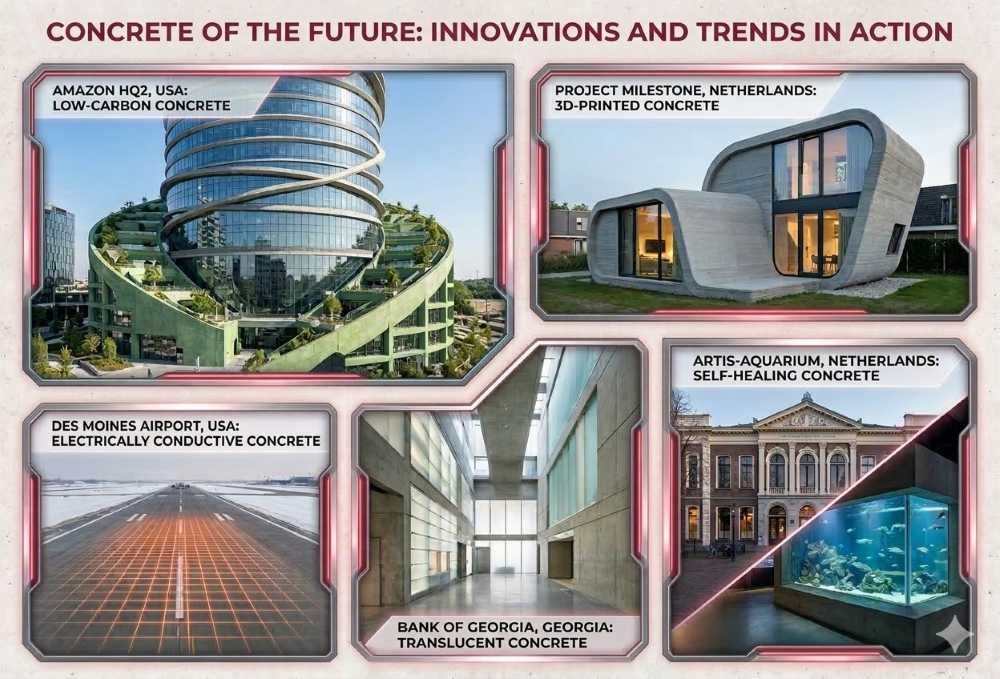
Amazon HQ2 (Arlington, USA)
The second headquarters of Amazon is one of the largest projects using CarbonCure technology. By injecting CO₂ into the concrete, the project has reduced carbon emissions by more than 1,000 tons—equivalent to planting thousands of acres of forest.
Project Milestone (Eindhoven, Netherlands)
This is the world’s first project of 3D-printed residential houses where people actually live. The homes resemble large boulders and demonstrate how the technology enables organic forms impossible with traditional formwork.
ARTIS Aquarium (Amsterdam, Netherlands)
The historic aquarium in Amsterdam uses self-healing concrete to repair its water tanks. Because cracks are inevitable in aggressive water environments, bacteria embedded in the concrete provide decades of durability without costly repairs.
Bank of Georgia (Tbilisi, Georgia)
One of the most famous buildings using translucent concrete (Litracon) in its interior, creating a unique interplay of light and giving a sense of lightness to an otherwise massive structure.
Des Moines International Airport (Iowa, USA)
Sections of electrically conductive concrete are being tested here. They automatically melt snow and ice during winter storms, eliminating the need for chemicals and snowplows.
Follow us on FB